
 EN
EN
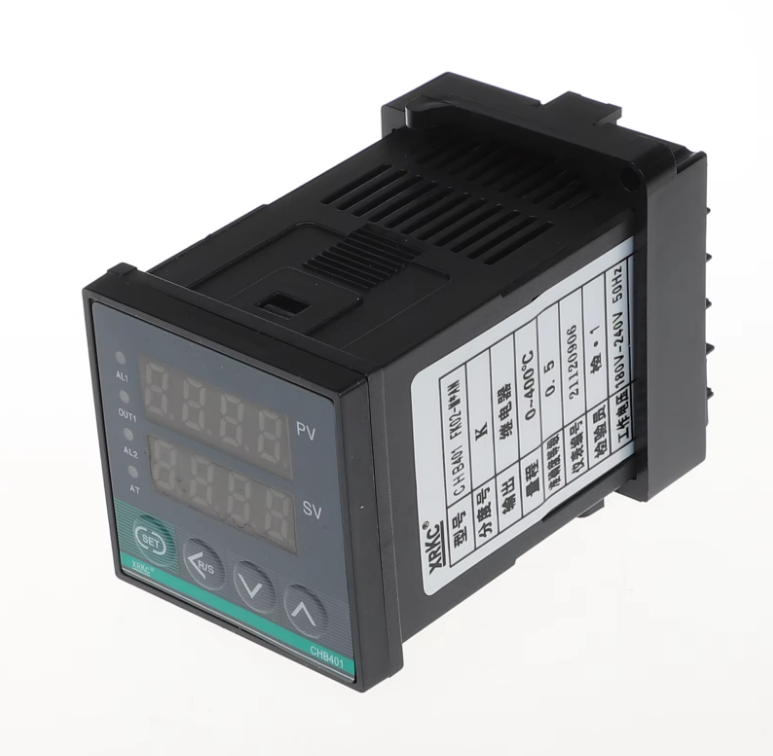
The Feedback Loop That Runs Modern Industry
Walk into any processing plant—chemical, pharmaceutical, food, or semiconductor—and chances are high that somewhere on the control panel, a PID temperature controller is quietly doing its job. These devices have been around for over a century, yet they remain the backbone of industrial temperature regulation. More than half of the controllers used in industry today are PID controllers. That is not nostalgia. That is testament to a control strategy that simply works.
At its core, a PID temperature controller is a closed-loop feedback mechanism. It continuously reads a process variable—temperature, in this case—from a sensor, compares it against a desired setpoint, and calculates a correction to drive the error toward zero. The "PID" stands for Proportional, Integral, and Derivative, three mathematical terms that each address a different aspect of the control challenge. Together, they allow the controller to respond to present error, past error, and predicted future error.
Proportional: The Immediate Responder
The proportional term is the simplest and most intuitive. It generates an output that is directly proportional to the current error—the difference between the setpoint and the actual temperature. If the temperature is 10 degrees below target, the controller applies a certain amount of heating power; if it is 5 degrees below, it applies roughly half that amount.
This sounds straightforward, but proportional-only control has a built-in limitation. Because the correction shrinks as the error shrinks, the system never quite reaches the setpoint. There is always a residual offset. A furnace set to 500°F might settle at 495°F and stay there indefinitely. The proportional term got the system close, but it could not finish the job.
That is where the integral term comes in.
Integral: The Accumulator That Eliminates Offset
Integral action looks at how long the error has persisted and accumulates it over time. The longer the temperature stays below setpoint, the more the integral term adds to the output, gradually pushing the system toward the target. This eliminates the steady-state offset that plagues proportional-only control.
But integral action is not without its own risks. If the integral gain is set too aggressively, the controller can overshoot—it keeps pushing even after the setpoint is reached, because it is still "paying off" accumulated error. If set too weakly, the system responds sluggishly to disturbances. Getting the integral term right requires understanding the process dynamics, and that is where experience—or a good autotune routine—becomes invaluable.
Derivative: The Predictive Brake
The derivative term is the least understood and most frequently misused of the three. It looks at the rate of change of the error—how fast the temperature is moving—and applies a correction that anticipates where the error is heading. Think of it as a predictive brake. When the temperature is approaching the setpoint quickly, derivative action reduces the output to prevent overshoot.
In theory, derivative action sounds like a perfect solution. In practice, it is tricky. Derivative terms amplify measurement noise, which can cause erratic control behavior. A noisy thermocouple signal can make the derivative term go haywire. That is why many industrial PID controllers include filtering on the process variable input, and why some practitioners simply set the derivative term to zero and rely on PI control instead.
How the Three Terms Work Together
A PID temperature controller does not use these terms in isolation. It sums them:
Output = Kp × Error + Ki × ∫Error dt + Kd × dError/dt
Each term contributes a portion of the total control signal. The proportional term provides the bulk of the corrective action. The integral term fine-tunes the output to eliminate steady-state error. The derivative term dampens the response to prevent overshoot and oscillation.
The challenge is that these terms interact. Changing the proportional gain affects how the integral and derivative terms behave. Tuning a PID controller is therefore an iterative process—adjust one parameter, observe the response, adjust another, and repeat.
| Tuning Parameter | Effect of Increasing Value | Risk of Over-Tuning |
|---|---|---|
| Proportional Gain (Kp) | Faster response, smaller error | Oscillation, instability |
| Integral Time (Ti) | Eliminates offset, faster correction | Overshoot, windup |
| Derivative Time (Td) | Reduces overshoot, stabilizes response | Noise amplification, erratic behavior |
A Real-World Example: The Chemical Reactor That Would Not Settle
A few years back, a specialty chemical plant in the Gulf Coast region was struggling with a 2,000-gallon jacketed reactor used for an exothermic polymerization reaction. The existing temperature controller—an old on-off type—was causing temperature swings of ±8°F around the setpoint. That might not sound like much, but for that particular reaction, a ±3°F deviation meant off-spec product. The plant was scrapping nearly 12% of each batch.
The engineering team replaced the on-off controller with a digital PID temperature controller and spent two days on manual tuning. They started with a conservative proportional band, introduced integral action to kill the offset, and added a small amount of derivative filtering to tame the overshoot during the exothermic peak. After tuning, the temperature stayed within ±1.5°F of setpoint throughout the reaction. Batch yield improved by over 10%, and the payback period on the controller upgrade was measured in weeks, not months.
That is the difference between a controller that just turns things on and off and one that actually thinks about what the temperature is doing and where it is headed.
The Limits of PID Control
For all its strengths, PID control is not a silver bullet. It works best on processes that are relatively linear and have consistent dynamics. Highly nonlinear processes, or those with long dead times, can push a standard PID controller past its limits. In those cases, advanced strategies like cascade control, feedforward compensation, or model predictive control may be necessary.
The ISA TR5.9-2023 technical report, published by the International Society of Automation, documents common PID algorithms used in industrial control systems and provides guidance on selection and application. It is a useful reference for anyone looking to move beyond guesswork and implement PID control with a solid engineering foundation.
Understanding what a PID temperature controller does is one thing. Knowing how to apply it effectively—and when to look for alternatives—is what separates a functional installation from a truly optimized one.