
 EN
EN
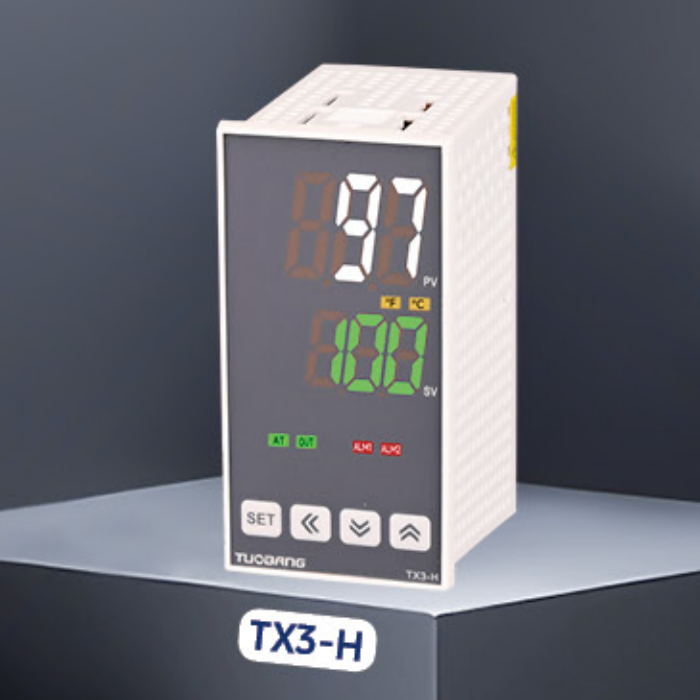
Thermocouples: The workhorse of high-temperature sensing
Walk into almost any industrial plant and you will find thermocouples scattered across furnaces, ovens, kilns, and exhaust streams. They are cheap, tough, and handle temperatures that would melt most other sensors. A standard temperature controller that accepts thermocouple inputs typically supports multiple letter-designated types—K, J, T, E, N, R, S, and B being the most common. Type K (chromel–alumel) covers -270°C to 1372°C and accounts for the vast majority of thermocouple installations in general-purpose industrial heating. Type J works well in vacuum or reducing atmospheres but maxes out around 1200°C. For high-temperature processes like glass manufacturing or heat treating, Type S and R handle up to 1450°C, while Type B pushes to 1700°C.
The compatibility question here is not binary—a controller either supports a given thermocouple type or it does not. But the real pitfall lies in cold junction compensation. Thermocouples measure the temperature difference between the sensing junction and the reference junction. If the controller’s internal compensation does not match the thermocouple type or the ambient temperature at the terminals drifts, the reading shifts. A poorly compensated Type K input can drift 5°C or more across a typical 40°C ambient swing. That is enough to scrap a batch of heat-treated components.
RTDs: Precision where it counts
When accuracy and repeatability matter more than range, resistance temperature detectors take the lead. PT100 RTDs dominate this category, with a measurement range of -200°C to 850°C and Class A accuracy of ±0.15°C at 0°C. Some controllers also support PT1000 or copper-based RTDs like Cu50. The PT100 operates on a simple principle—resistance changes predictably with temperature, following the IEC 60751 standard curve.
A standard temperature controller with RTD input typically uses a three-wire or four-wire connection to compensate for lead resistance. Two-wire RTDs work for short runs but introduce error in longer cable lengths—roughly 0.4°C per ohm of lead resistance. That means a 10-meter cable run using 24 AWG wire can add nearly 2°C of error if the controller is not configured for three-wire sensing. Many field technicians miss this detail and end up chasing phantom process variations.
One facility in southern China retrofitting an aging injection molding line swapped out failed thermocouples for PT100 RTDs on the barrel zones. The engineers assumed the new sensors would drop in without issue. But the existing temperature controllers were configured for Type K and lacked RTD input hardware. Replacing all eight controllers would have cost nearly twelve thousand dollars and taken the line down for three days. The workaround involved installing RTD transmitters that converted the PT100 signal to a 4-20mA loop, which the controllers could read. The fix worked, but it added nearly two hundred dollars per zone in transmitter costs and introduced an extra point of failure. The lesson: verify the controller’s input hardware before committing to a sensor type.
Thermistors: Economical but curve-sensitive
Thermistors—both NTC (negative temperature coefficient) and PTC (positive temperature coefficient)—show up in applications where cost and sensitivity outweigh absolute accuracy. NTC thermistors are the more common choice for temperature measurement, offering high sensitivity in a narrow range, typically -50°C to 150°C. A 10K NTC thermistor at 25°C changes resistance by roughly 4% per degree Celsius, making it far more responsive than a PT100 at the same temperature.
But here is where compatibility gets tricky. Two thermistors both labeled “10K Type II” can match resistance at 25°C and still diverge significantly across the operating range. The controller interprets resistance based on a predefined resistance-temperature curve. If the curve stored in the controller does not match the actual curve of the installed thermistor, every temperature reading carries a systematic error. A mismatch that looks fine at room temperature can produce a 3°C to 5°C offset at 80°C—precisely the range where many HVAC and environmental chambers operate.
Some standard temperature controllers allow the user to select from a library of thermistor curves (Type II, Type III, and various manufacturer-specific tables). Others only support a single curve. Buying replacement thermistors from the same supplier as the original controller reduces the risk, but even then, manufacturers occasionally revise sensor formulations without changing the part number. The safest approach is to confirm the curve specification directly with both the controller and sensor manufacturers.
| Sensor Type | Typical Temperature Range | Typical Accuracy | Response Speed | Relative Cost |
|---|---|---|---|---|
| Thermocouple (Type K) | -270°C to 1372°C | ±1.0°C to ±2.5°C | Fast | Low |
| RTD (PT100) | -200°C to 850°C | ±0.15°C to ±0.3°C | Moderate | Medium |
| NTC Thermistor | -50°C to 150°C | ±0.2°C to ±1.0°C | Fast | Low |
| RTD (PT1000) | -200°C to 850°C | ±0.15°C to ±0.3°C | Moderate | Medium-High |
Linear inputs: Analog signals from transmitters
Many modern temperature controllers accept linear analog inputs—4-20mA, 0-10V, or 0-5V—in addition to direct sensor inputs. This matters because a growing number of installations use temperature transmitters that convert sensor signals into standardized industrial loops. A PT100 connected to a smart transmitter outputs a 4-20mA signal proportional to temperature, which any controller with a mA input can read. The controller does not care whether the source is a thermocouple, RTD, or thermistor—it only sees the current loop.
This approach solves the compatibility problem in one move but introduces calibration overhead. The transmitter must be scaled correctly to match the controller’s input range. A common mistake: setting the transmitter for 0-200°C while the controller expects 0-100°C. The result is a reading that is exactly double the actual temperature. Some controllers offer user-configurable input scaling; others require the transmitter to match a fixed range. Checking this during commissioning saves hours of troubleshooting downstream.
According to IEC 60730-2-9, automatic electrical temperature sensing controls must include provisions for sensor failure detection—often called “sensor break detect”. Controllers with linear inputs should still implement this feature, but the implementation varies. Some detect a broken sensor by looking for an out-of-range signal (below 4mA or above 20mA). Others require a separate diagnostic channel. When selecting a controller for a transmitter-based system, verify how the controller handles sensor faults. A controller that fails to detect a broken transmitter can continue operating on a stale reading, potentially damaging equipment.
Sensor break detection and configuration gotchas
No discussion of sensor compatibility is complete without addressing configuration errors. The single most common compatibility issue in the field is not hardware incompatibility—it is misconfiguration. A controller might support both thermocouple and RTD inputs, but the input type parameter must be set correctly for the connected sensor. Many controllers default to Type K thermocouple. Connect a PT100 without changing the setting, and the display shows a temperature that is wildly incorrect.
One maintenance team at a food processing plant spent two days replacing a “faulty” RTD on a pasteurization line, only to discover that the controller’s input type had been accidentally changed from PT100 to Type K during a firmware update. The sensor was perfectly fine. The controller was reading the RTD as if it were a thermocouple, producing a 150°C offset that tripped the high-temperature alarm every morning. The fix took thirty seconds once the root cause was identified.
Sensor break detection adds another layer. A controller with this feature alerts operators when the sensor opens or shorts. But the feature only works if the controller is configured for the correct sensor type. A thermocouple behaves differently from an RTD when open-circuited—thermocouples tend to drift toward ambient, while RTDs may show an open-scale reading. Some controllers allow the user to define a “sensor break” output value that drives the process to a safe state. This setting is often overlooked during initial setup.
Making the right call for your application
Choosing the right sensor for a standard temperature controller comes down to three questions. What temperature range does the process require? How much accuracy is actually needed? And what is the existing controller hardware capable of accepting?
For processes above 600°C, thermocouples are effectively the only option. Below that, RTDs offer better accuracy and stability. Thermistors work well for narrow-range, cost-sensitive applications where high sensitivity is valued over absolute precision. Linear inputs via transmitters provide the most flexibility but add cost and calibration complexity.
Many controllers on the market today are “universal input” designs that accept multiple sensor types through software configuration. These offer the greatest flexibility but demand careful attention during setup. A universal input controller does not automatically detect the connected sensor—the operator must select the correct type through the configuration menu.
For B2B buyers sourcing temperature controllers in volume, the compatibility landscape matters not just for the initial installation but for long-term maintenance. Standardizing on one or two sensor types across the facility reduces spare parts inventory and simplifies technician training. Mixing sensor types increases the risk of configuration errors during emergency repairs.
Manufacturers like Suosite produce a range of temperature controllers and solid-state relays designed for industrial automation environments, with input configurations that accommodate thermocouples, RTDs, and linear signals across multiple product lines. The company’s manufacturing capabilities and quality control processes support consistent performance across high-volume production runs, making them a practical choice for procurement teams that value supply chain reliability.