
 EN
EN
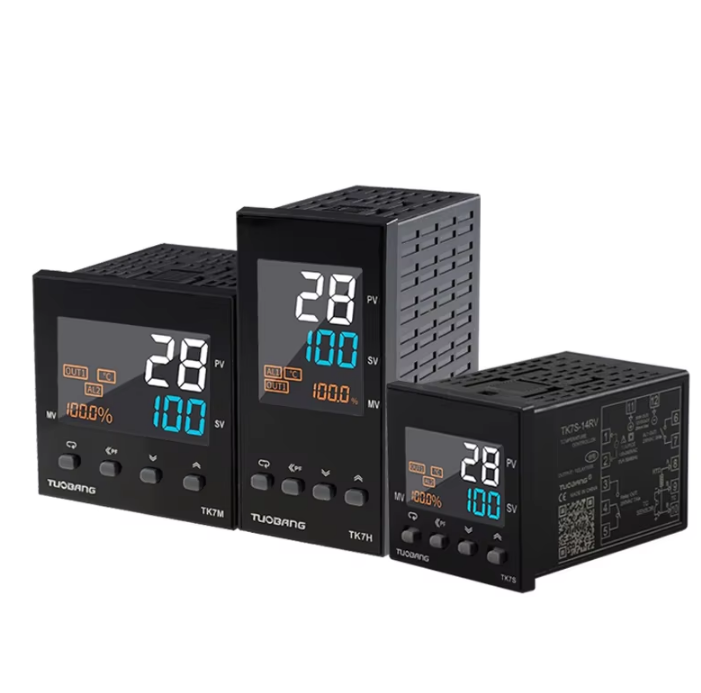
More Than a Component—A Critical Enabler
Walk through almost any modern production facility, and the chances of spotting a PID temperature controller on a panel are remarkably high. These devices have become so embedded in industrial infrastructure that they are often taken for granted—until something goes wrong. The global PID digital temperature controllers market was valued at approximately $1.22 billion in 2025 and is projected to grow at a compound annual growth rate exceeding 10% through 2032. That kind of growth does not happen by accident. It reflects a fundamental truth: across a widening spectrum of industries, maintaining precise temperature is no longer a luxury—it is a prerequisite for viable operations.
The question is not whether PID controllers are useful. The question is which industries depend on them most—and why.
Semiconductor Manufacturing: Where a Single Degree Can Kill Yield
Semiconductor fabrication is perhaps the most temperature-sensitive manufacturing process on the planet. Wafer processing involves dozens of thermal steps—oxidation, deposition, etching, annealing—each requiring temperature control within incredibly tight tolerances. In rapid thermal processing (RTP) equipment, for example, wafers are heated to over 1,000°C in seconds and must maintain uniform temperature across the entire wafer surface. A temperature gradient of just a few degrees across a 300mm wafer can cause non-uniform film deposition, leading to chip failures downstream.
The economics are brutal. A single 300mm wafer can yield hundreds of chips, and a 1% drop in yield on a high-volume production line can translate into millions of dollars in lost revenue annually. That is why semiconductor fabs deploy multi-zone PID control systems that independently regulate different heating zones within the same chamber. Each zone has its own PID loop, tuned to the specific thermal dynamics of that region. The controller continuously adjusts power to each heating element, compensating for edge effects, heat loss, and load changes.
What makes semiconductor applications particularly demanding is the speed requirement. Many thermal processes run on cycles measured in seconds. The PID controller must not only be accurate but also responsive—able to anticipate overshoot and correct before the temperature drifts outside the process window.
Food and Beverage Processing: Safety and Consistency on the Line
Food manufacturing runs on temperature. Pasteurization, baking, frying, fermentation, drying—each of these operations has a narrow temperature band where the product comes out right. Go above that band and you risk quality degradation or even safety failures. Go below and you might not achieve the required pathogen kill or proper texture development.
A PID temperature controller addresses this challenge by modulating heating or cooling output continuously rather than switching on and off like a simple thermostat. The difference shows up in product consistency. In a continuous baking oven, for instance, zone-to-zone temperature variations directly affect browning and moisture content. With PID control, each zone can be held within ±1–2°F of setpoint, producing uniform results batch after batch.
The regulatory dimension matters too. HACCP plans require documented evidence that critical temperature limits are met during processing. A controller with accurate sensors and stable PID performance gives quality teams the confidence—and the data—to demonstrate compliance. For manufacturers shipping products across borders, that documentation is not just good practice; it is a market access requirement.
Pharmaceutical and Biotechnology: Where Precision Is Non-Negotiable
Pharmaceutical manufacturing operates under some of the strictest quality standards in any industry. Temperature control touches nearly every stage of drug production—from fermentation in bioreactors to sterilization in autoclaves to storage in cold-chain logistics.
Bioreactors are a particularly telling example. These vessels cultivate living cells—bacteria, yeast, mammalian cells—that produce therapeutic proteins, vaccines, and other biologics. Cell growth and protein expression are exquisitely temperature-sensitive. A deviation of even 0.5°C from the optimal growth temperature can reduce yield or alter the product's characteristics.
In one documented biopharmaceutical application, a production line with 16 bioreactors required each reactor to maintain approximately 37°C for week-long runs. The ambient temperature fluctuated between 20°C and 30°C, meaning the controller had to work against varying environmental conditions. After PID parameter tuning, the initial heating overshoot was reduced to just 0.3°C, with long-term stability maintained around the setpoint. That level of precision is not about convenience—it is about protecting multi-million-dollar batches of biologic drugs.
Cleanroom HVAC systems in pharmaceutical facilities also rely heavily on PID control. These systems must maintain not only temperature but also humidity and pressure differentials within narrow ranges to protect product integrity and operator safety.
| Industry | Typical Temperature Tolerance | Primary Control Challenge | Consequence of Poor Control |
|---|---|---|---|
| Semiconductor | ±0.5–1.5°C | Rapid thermal cycles, multi-zone uniformity | Yield loss, scrapped wafers |
| Food & Beverage | ±1–3°F | Variable load, product changes | Inconsistent quality, safety risk |
| Pharmaceutical | ±0.3–0.5°C | Long run times, environmental variation | Batch failure, regulatory action |
| Chemical Processing | ±2–5°C | Exothermic reactions, nonlinear dynamics | Off-spec product, runaway reactions |
| Plastics | ±1–2°F | Multi-zone barrels, material changes | Dimensional defects, scrap |
Chemical Processing: Taming Exothermic Reactions
Chemical reactors are among the most challenging environments for temperature control. Many reactions are exothermic—they release heat as they proceed. If the temperature rises too fast, the reaction accelerates, releasing even more heat in a positive feedback loop that can lead to a runaway condition. If the temperature drops too low, the reaction slows or stops, wasting raw materials and time.
PID controllers are the workhorse of reactor temperature management. They typically operate in a cascade configuration: one PID loop controls the reactor temperature, while a second loop controls the temperature of the heat transfer fluid in the jacket or coil. This arrangement allows the system to respond quickly to disturbances in the utility supply while maintaining stable reactor conditions.
A specialty chemical plant in the Gulf Coast region struggled for months with a 2,000-gallon jacketed reactor used for an exothermic polymerization. The existing on-off controller caused temperature swings of ±8°F around the setpoint. For that particular reaction, a ±3°F deviation meant off-spec product—and the plant was scrapping nearly 12% of each batch. After upgrading to a digital PID controller with proper tuning, the temperature stayed within ±1.5°F of setpoint throughout the reaction. Batch yield improved by over 10%.
That case is not unusual. In chemical processing, the gap between good control and poor control is measured in product quality, raw material utilization, and safety margin.
Plastics and Polymer Processing: Heat Management from Barrel to Mold
Plastics processing—injection molding, extrusion, blow molding, thermoforming—is fundamentally a thermal operation. Raw polymer pellets are melted, formed, and cooled. Every step requires precise temperature management.
In injection molding, the barrel is divided into multiple heating zones, each with its own thermocouple and PID controller. The temperature profile along the barrel determines how the polymer melts and flows. If one zone runs too hot, the material can degrade, releasing gases that cause surface defects. If a zone runs too cold, the melt viscosity increases, leading to short shots or flow marks.
Hot runner systems add another layer of complexity. These systems keep the plastic molten in the manifold and nozzles between injection cycles, eliminating the need to re-melt the sprue. Each nozzle and manifold zone requires independent temperature control. Modern hot runner controllers use PID algorithms to maintain each zone within ±1°F of setpoint, ensuring consistent melt temperature at every cavity. The result is shorter cycle times, lower scrap rates, and more consistent part dimensions.
The same principles apply to extrusion, where barrel temperature profiles directly affect melt uniformity and final product properties. In profile extrusion, temperature variations as small as 2°F can cause dimensional changes that render the product unusable.
HVAC and Data Centers: The Invisible Infrastructure
Not all PID controller applications involve manufacturing. Building HVAC systems and data center cooling represent a massive and growing segment of the market.
Commercial buildings consume enormous amounts of energy for heating and cooling. PID controllers in HVAC systems modulate dampers, valves, and fan speeds to maintain comfort conditions while minimizing energy use. Studies show that more than 90% of industrial controllers are based on PID architecture, and HVAC is one of the largest application areas.
Data centers present a particularly acute case. Server racks generate massive heat loads that must be removed continuously to prevent equipment damage and downtime. Cooling can account for 30–40% of a data center's total energy consumption. PID controllers regulate chilled water valves, fan speeds, and compressor operation to maintain server inlet temperatures within specified ranges. Research has demonstrated that optimized PID-based control strategies can reduce cooling energy consumption by approximately 12% compared to traditional approaches while maintaining required temperature stability.
A Final Observation
The industries that benefit most from PID temperature controllers share a common characteristic: temperature is not a minor variable but a critical process parameter that directly affects product quality, safety, or economics. Semiconductor fabs, food plants, pharmaceutical facilities, chemical reactors, plastics processors, and data centers all operate in regimes where temperature control is non-negotiable.
The controllers themselves are remarkably similar across these applications—same PID algorithm, same basic hardware architecture. What differs is the tuning, the sensor selection, the control configuration, and the understanding of process dynamics. That is why application expertise matters as much as the hardware itself.
For organizations specifying temperature control equipment, working with a supplier that understands the nuances of their particular industry—and can provide the application support to match—makes a tangible difference. Companies like SST, with deep roots in temperature control manufacturing and a track record of supporting diverse industrial applications, offer the kind of practical knowledge that turns a controller into a solution rather than just another component on the panel.
Table of Contents
- More Than a Component—A Critical Enabler
- Semiconductor Manufacturing: Where a Single Degree Can Kill Yield
- Food and Beverage Processing: Safety and Consistency on the Line
- Pharmaceutical and Biotechnology: Where Precision Is Non-Negotiable
- Chemical Processing: Taming Exothermic Reactions
- Plastics and Polymer Processing: Heat Management from Barrel to Mold
- HVAC and Data Centers: The Invisible Infrastructure
- A Final Observation