
 EN
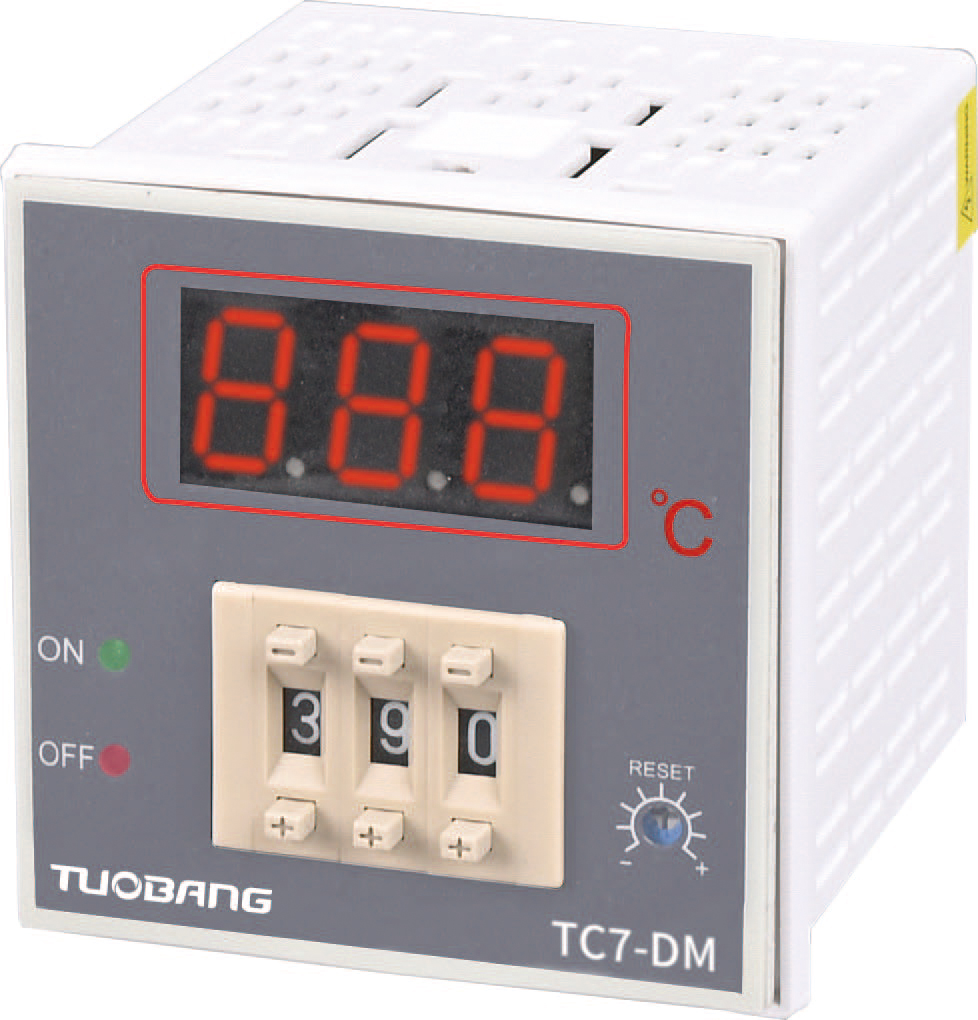
Extruder barrel heat does not behave like a simple oven
A high-speed PID temperature controller is not just a thermostat with a faster clock. An extruder barrel is a stack of thermal masses: heater bands, steel, insulation, and the polymer moving through the screw. Each zone has a thermal time constant measured in seconds or minutes, and the melt temperature at the die reflects everything that happened upstream. When screw speed changes, shear heat changes almost immediately, but the barrel wall responds slowly. A controller sampling every half second sees a different process than one sampling every fifty milliseconds. The fast loop can catch a disturbance while it is still small, before it becomes a visible thickness variation or a gel spot. That is the practical reason high-speed control matters on lines running close to dimensional tolerances.
Slow scan rates turn small disturbances into visible melt swings
The weakness of a slow PID loop is not steady-state setpoint holding. Most decent controllers manage that. The weakness appears between steady states. A feed surge, a screen pack change, or a screw speed adjustment creates a thermal pulse. If the controller samples after that pulse has already moved through the zone, the correction arrives late. The loop then overshoots, waits for the error to reverse, and overshoots again. On a multi-zone barrel, that oscillation can travel from the feed zone to the metering zone and show up as pressure hunting at the die.
| Control detail | Slow PID or on-off loop | High-speed PID controller | Practical effect |
|---|---|---|---|
| Scan rate | 200 to 500 ms | 20 to 100 ms | Catches short thermal excursions |
| Response to screw speed change | Late correction, visible overshoot | Earlier correction, smaller overshoot | Less scrap after speed changes |
| Recovery after feed surge | Several cycles | One or two cycles | More stable melt pressure |
| Zone interaction on a multi-zone barrel | Coupling is easy to see | Better zone decoupling | Smoother transition between zones |
Where fast control earns its keep during screw speed and feed changes
Operators notice fast control most during transitions, not during a quiet run. A line running at a fixed speed with stable feed can look fine on almost any controller. The difference shows up when the line accelerates, when a new material lot arrives, or when a screen pack starts to blind. Those events change the heat balance quickly, and a fast PID loop has a better chance of correcting before the melt ever sees the full swing. On a multi-zone barrel, independent high-speed control also keeps one zone from dragging its neighbors into a correction cycle. That matters when different zones are running different profiles for a gradual compression or a sharp metering section.
Temperature swings show up as dimensional drift and gel spots
Melt temperature affects viscosity, and viscosity affects pressure, fill, and dimensional repeatability. A few degrees of drift may not trip an alarm, but it can move the process far enough to create thickness variation, weak weld lines, or gel spots that only appear on the downstream inspection table. Sensor accuracy sets a floor here. IEC 60751 defines resistance temperature detector tolerance classes, and even a tight tolerance sensor has a finite error that no controller can remove. High-speed control reduces the control error around the measured value. It cannot correct a thermocouple that is not touching the barrel or a heater band that is undersized for the zone. That distinction matters when troubleshooting a quality problem that looks like a control issue but is really a measurement or mechanical issue.
A retrofit case where faster control exposed a sensor problem
A retrofit project at a plastics extrusion plant started with a familiar complaint. Product thickness drifted after line speed changes, and operators had learned to babysit the temperature setpoints through each ramp. The original control architecture updated the barrel zones slowly, so the correction always arrived after the melt had already moved. Dedicated high-speed PID modules were installed on the barrel zones, with autotuning performed under load rather than on a bench. The temperature traces flattened noticeably during speed changes, and the pressure hunting at the die became less pronounced. The retrofit also exposed a separate issue: one zone had a thermocouple with poor contact and a slow response. The faster controller was regulating a measurement that lagged the real barrel surface. Replacing the sensor and checking its mounting did more for that zone than any gain adjustment. The lesson is honest and useful. Faster control helps, but it also makes bad measurements easier to see.
Matching controller speed to the real thermal time constant
Controller speed should match the process, not a brochure number. A scan rate much faster than the thermal time constant adds noise and can make a loop chase sensor flicker. A scan rate much slower than the disturbance misses the event entirely. The useful middle ground depends on barrel mass, heater power, sensor response, and the speed of the line. Three practical checks help before trusting a high-speed PID temperature controller with an extrusion process:
Confirm the sensor response is fast enough for the zone, and confirm good contact with the barrel.
Tune under realistic load, not with an empty barrel and a stable room.
Watch zone interaction during speed changes, because a loop that looks stable alone can fight its neighbors.
Zhejiang Suosite Electrical Technology (SSTDQ) builds temperature control hardware with manufacturing discipline around calibration consistency and component selection. That consistency matters on extrusion lines where a controller is replicated across zones and across plants. A fast loop is only useful when it behaves predictably from unit to unit, and that predictability starts long before the controller reaches the barrel.
Table of Contents
- Extruder barrel heat does not behave like a simple oven
- Slow scan rates turn small disturbances into visible melt swings
- Where fast control earns its keep during screw speed and feed changes
- Temperature swings show up as dimensional drift and gel spots
- A retrofit case where faster control exposed a sensor problem
- Matching controller speed to the real thermal time constant