
 EN
The three knobs that determine everything
Every PID controller has three parameters that shape its behavior. They go by different names depending on the manufacturer. Proportional band, integral time, derivative time. Or gain, reset, rate. Or simply P, I, and D. The names matter less than what they actually do.
The proportional parameter sets the relationship between error and output. A small proportional band means the controller reacts aggressively to even a small deviation from setpoint. A large band means the controller is gentle, correcting slowly. Most temperature controllers express this as proportional band in degrees or as a percentage of the input span. Some use proportional gain instead, which is simply the inverse of the band. A gain of 10 corresponds to a band of 10 percent of span.
The integral parameter, often called reset, determines how quickly the controller eliminates the remaining error after proportional action has done its work. It is expressed as time. A shorter integral time means the controller adds output more aggressively to close the final gap. A longer integral time means it takes a slower, more measured approach. In some controllers, this parameter appears as repeats per minute rather than time, which is the reciprocal of the same concept.
The derivative parameter, sometimes called rate, responds to the speed of temperature change. Its job is to put the brakes on when the temperature is rising fast and the setpoint is near. It is expressed in time, and in most temperature loops it is either set to a small value or left at zero.
Reading the parameter units without getting confused
One of the biggest sources of confusion in PID tuning is that manufacturers use inconsistent units. A controller from one brand might define the proportional term as a band in engineering units, while another defines it as a dimensionless gain. The integral term might be seconds per repeat or repeats per minute. The derivative might be seconds or minutes.
The practical approach is to ignore the labels and focus on the direction of change. For proportional band, a smaller number means more aggressive response. For gain, a larger number means more aggressive. For integral time, a smaller number means faster elimination of offset. For derivative time, a larger number means stronger anticipation.
A quick check in the controller manual is worth the effort. Guessing wrong about whether integral is in seconds or minutes can waste hours of tuning time.
What each parameter does to the temperature curve
Proportional action determines the shape of the approach to setpoint. With too little proportional action, the temperature rises slowly and may never get close to the target. With too much, the temperature overshoots and then oscillates as the controller swings back and forth between too much and too little output.
Integral action determines whether the temperature actually reaches the setpoint. Without enough integral action, a persistent gap remains between the actual temperature and the target. With too much integral action, the controller winds up during startup and then overshoots dramatically before settling. The integrator has been accumulating error during the long approach and releases all that accumulated output at once.
Derivative action shapes the final approach and helps suppress overshoot. It is most useful in processes where the heater responds quickly relative to the thermal mass. In sluggish processes, the derivative term sees the temperature changing slowly and does very little. In noisy processes, it sees sensor fluctuations and produces erratic output changes.
| Parameter | Too Low | Just Right | Too High |
|---|---|---|---|
| Proportional | Slow response, large steady-state error | Prompt response, manageable overshoot | Oscillation, excessive overshoot |
| Integral | Persistent offset from setpoint | Error eliminated within reasonable time | Overshoot on startup, hunting |
| Derivative | Overshoot on approach, sluggish settling | Smooth approach, reduced overshoot | Noise amplification, erratic output |
A practical starting point that usually works
There is no universal recipe for PID tuning, but there is a starting point that works for a surprising number of temperature loops. Set the proportional band to a value that corresponds to roughly five to ten percent of the expected temperature span. Set the integral time to a few minutes. Leave the derivative at zero.
From that starting point, the proportional band can be tightened if the approach to setpoint is too slow, or widened if oscillation appears. The integral time can be shortened if a steady offset persists, or lengthened if the startup overshoot is excessive. The derivative can be introduced only after proportional and integral are reasonably well behaved, and only if overshoot is still a problem that proportional and integral adjustments cannot solve.
A process with a large heater relative to the load will need a wider proportional band and a longer integral time than a process with a small heater and a light load. The ratio of heater power to thermal mass determines how aggressively the controller can act before instability sets in.
The Ziegler-Nichols method and why it needs adaptation
The Ziegler-Nichols ultimate sensitivity method is the most widely cited tuning procedure in control engineering textbooks. The procedure is to set integral and derivative to zero, then increase proportional gain until the system oscillates continuously. The gain at which this happens is called the ultimate gain, and the period of oscillation is the ultimate period. From those two values, the textbook provides formulas for proportional, integral, and derivative settings.
The problem is that the Ziegler-Nichols formulas were developed for processes where a quarter-amplitude decay ratio was considered acceptable. In temperature control, that level of oscillation is almost never acceptable. The method produces a starting point, not a final answer. The proportional gain usually needs to be reduced, and the integral time lengthened, to bring the loop into a range where the temperature is stable enough for production.
A more practical adaptation is to take the Ziegler-Nichols result and halve the proportional gain, double the integral time, and leave the derivative at the Ziegler-Nichols value. This conservative version trades a slower response for much better stability, which is usually the right trade in temperature control.
The chemical plant lesson
At a specialty chemical plant, a reactor temperature loop had been tuned with aggressive settings that produced excellent response to setpoint changes but oscillated whenever a new batch of raw material was charged. The oscillation was traced to the integral term, which had been set short enough that the controller reacted to normal process noise. Lengthening the integral time by a factor of three eliminated the oscillation without noticeably slowing the response to legitimate setpoint changes.
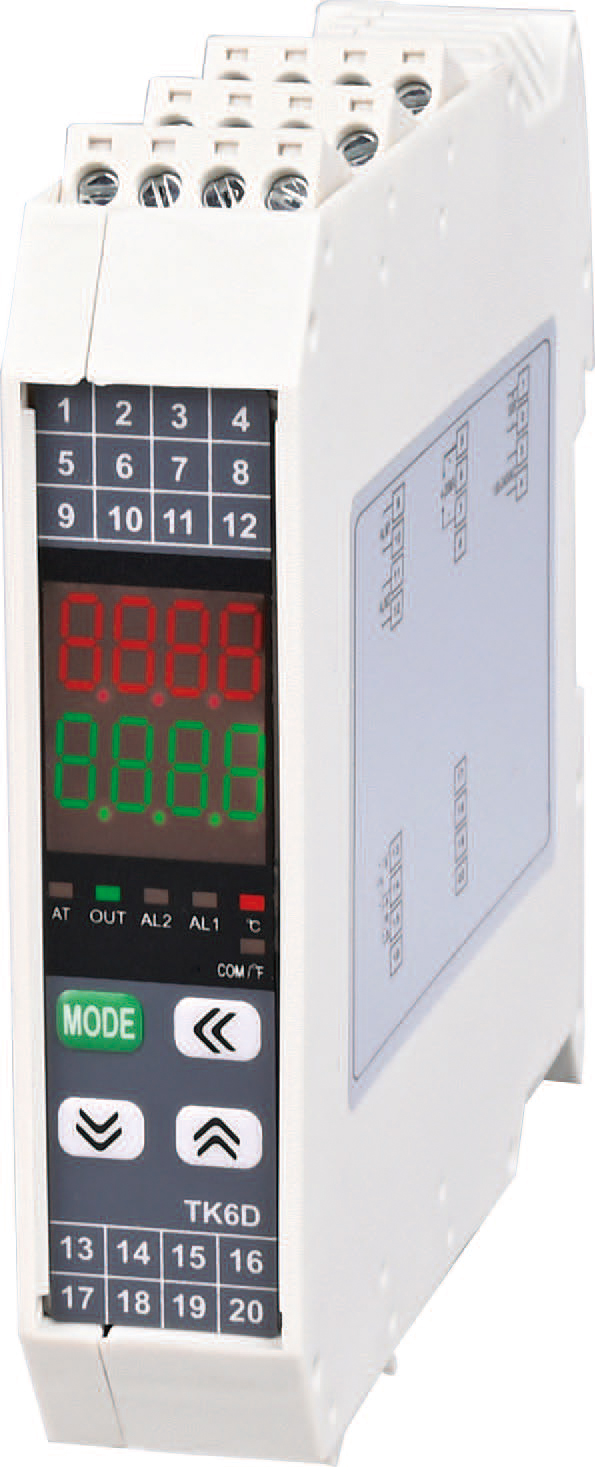
Suosite’s controllers support the common parameter conventions and provide both autotuning and manual tuning modes. For panel builders who standardize on a single controller platform, having consistent parameter behavior across the product range simplifies the tuning process and reduces the learning curve when moving between projects.